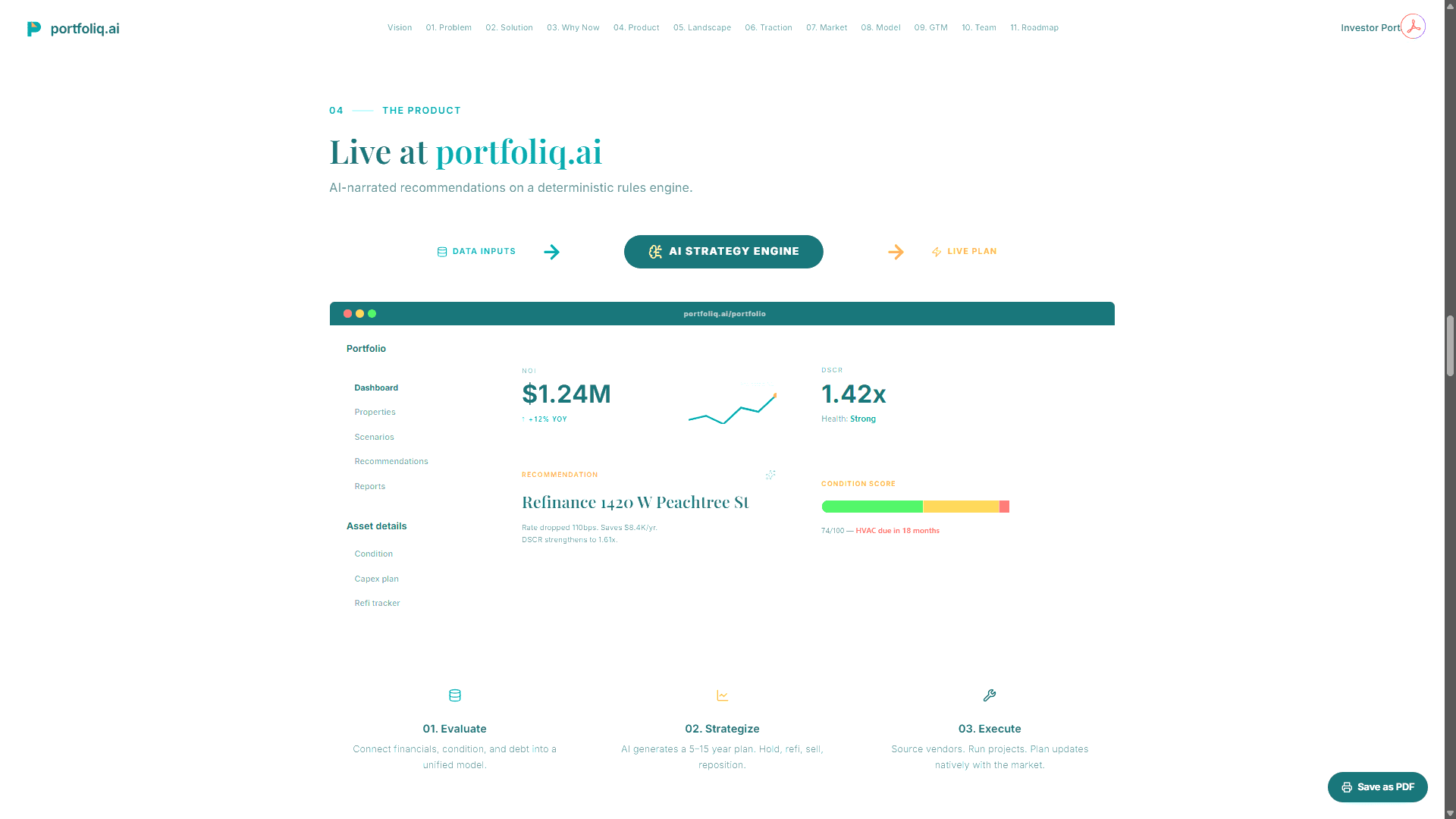
Ten million Americans own roughly $4 trillion of U.S. real estate, and almost none of them get told what to do with it next. Own 200,000 units and you have a team of asset managers; own three, like most landlords, and you get a spreadsheet and a stack of statements. Portfoliq closes that gap.
I designed, built, and shipped the entire platform myself — and own every line of production code. It is live today with paying customers.
- First month revenue
- $8,723
- Prepaid users
- 13
- Signed pipeline
- $48,650
- Lines of production code
- Every one
What it does
Evaluate — financials, condition, and debt are unified into one model of the portfolio.
Strategize — an AI strategy engine generates a 5-to-15-year plan: hold, refinance, sell, or reposition, narrated in plain language on top of a deterministic rules engine.
Execute — source vendors, run projects, and the plan updates natively as the market moves.
The part I'm proudest of
A document-import pipeline that uses Claude to extract structured deal data from messy real-estate PDFs, rent rolls, and lender statements — turning unstructured documents into clean underwriting inputs with no manual data entry.
Under the hood: Next.js on Vercel, Supabase (Postgres + pgvector) for storage and semantic retrieval, and the Anthropic API driving extraction and the recommendation narration.
Traction
Incorporated in April; paying customers by May. First month closed $8,723 in revenue with 13 prepaid users and a signed pipeline of $48,650.
Two ways in, one recurring platform: a white-glove consulting engagement for owners who want the plan built for them, and self-serve software for owners who want to run it themselves. Both feed the same live dashboard and advisory loop.
Built with