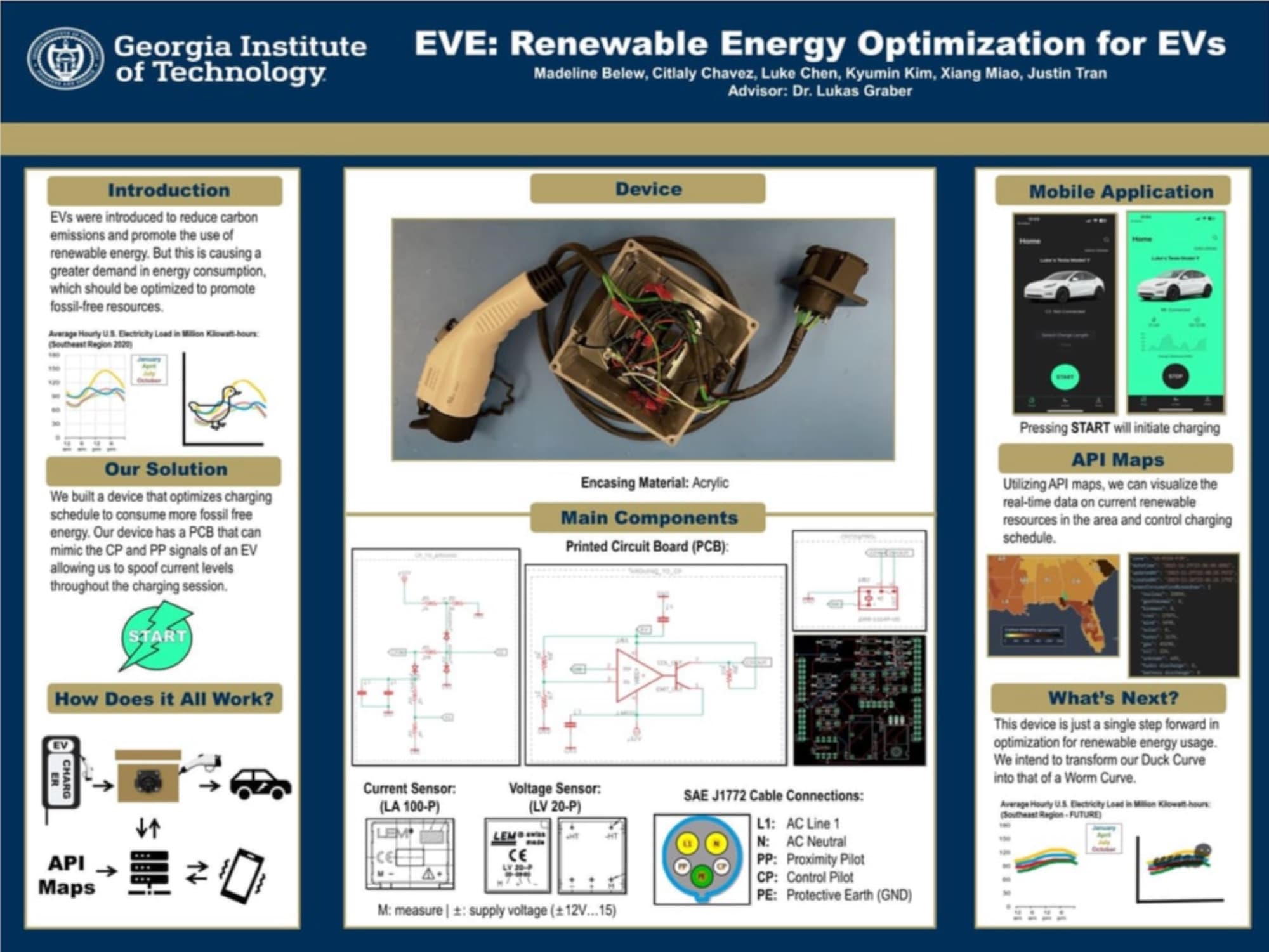
EVs were meant to cut carbon, but they also pile demand onto a grid that is dirtiest at peak hours — the classic "duck curve." EVE optimizes when a car charges so more of that energy comes from fossil-free sources, without the owner thinking about it.
I built the mobile app and software that ties the hardware to real-time grid data. The device sits between the wall and the car and quietly reshapes the charging session based on how clean the grid is right now.
- Peak charge rate
- 21 kW
- Standard
- SAE J1772
- Live signals
- CP + PP
- Data sources
- Grid + weather
How it works
A custom PCB mimics the Control Pilot (CP) and Proximity Pilot (PP) signals of an EV over the SAE J1772 interface, letting the device spoof the advertised current level and throttle charging up or down throughout a session.
A TI Launchpad runs the power-management algorithm, pulling live clean-energy availability from the Electricity Maps API and conditions from OpenWeather. A React Native + TypeScript app talks to a Firebase backend that syncs charge state with the hardware.
The hard part
Cutting current without the car interpreting it as a charging fault. EVs expect the charge-control signals to behave a certain way; throttle too bluntly and the vehicle aborts the session. Getting the spoofed CP/PP signals right so the car kept charging happily at a reduced rate was the core engineering challenge.
The app
The app gives the owner a single control surface: start or stop a charge, pick a charge length, and watch power delivered in real time. An activity view breaks down the fossil-free vs. fossil-fueled mix of the current session and logs clean-energy delivered over time, while a profile view manages multiple vehicles.
Built with